


Senior Designers Kelly Trotz, Samantha Schoell, and Lauren Feurich at the Wolf | Sub-Zero | Cove campus in Madison, Wisconsin.
What Happens When Your Kitchen Designers Go Back to School
Senior Designers Kelly Trotz, Samantha Schoell, and Lauren Feurich recently made the trip to Madison, Wisconsin for an immersive training at the Wolf | Sub-Zero | Cove headquarters. Trips like this are how we move beyond knowing a product’s specifications to truly understanding what’s behind them — the manufacturing philosophy, the quality controls, the engineering decisions that separate one brand from another. It’s what lets us speak about these appliances with real authority when we’re helping a client decide what belongs in their kitchen.
More Than a Product Demo
Designer trainings can range from a polished sales presentation to something genuinely useful. This one landed firmly in the latter category. Rather than working through specification sheets, the Wolf | Sub-Zero | Cove team demonstrated every appliance in real cooking situations — multiple times — while explaining the engineering and real-world experience behind each product.
“It really shifted the way I view appliance education and how we present these products to clients,” said Samantha. “Watching the Wolf range, induction cooktop, griddle, and steam oven being actively used while bonafied chefs explained the features and cooking techniques helped connect the technical details to how homeowners actually live and entertain.”
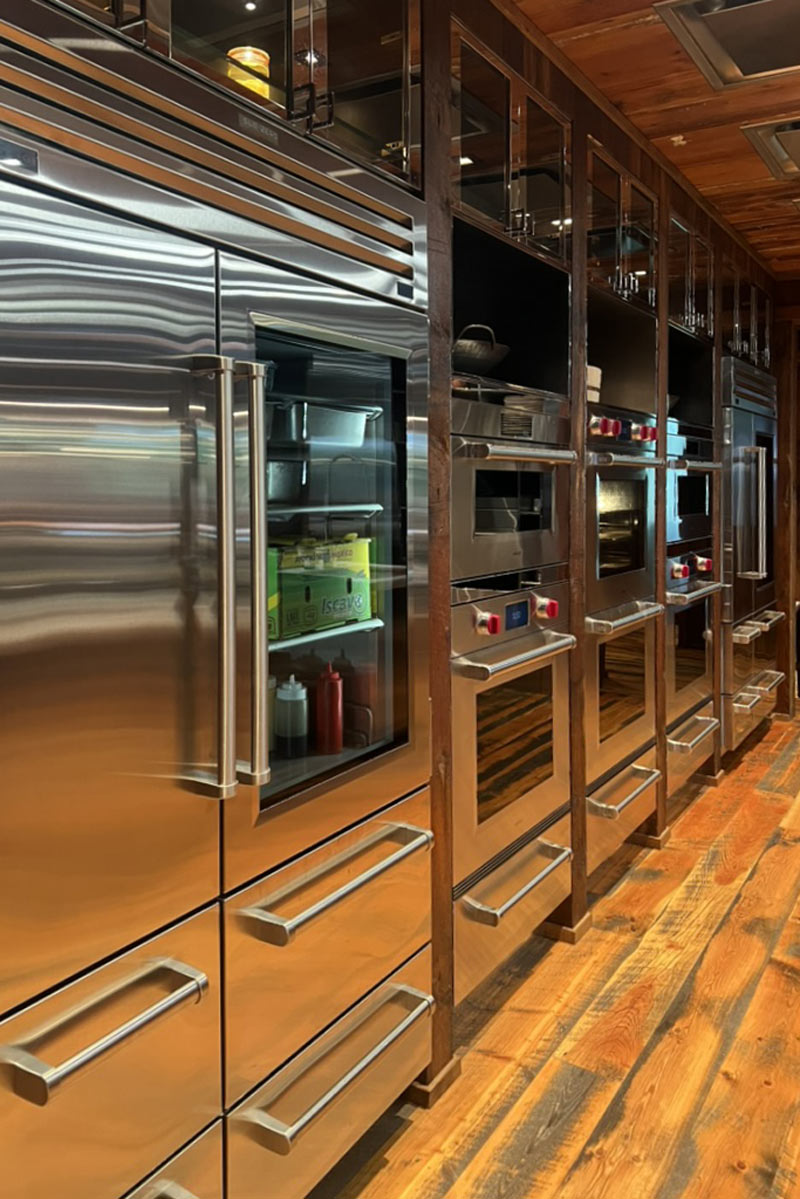
The Sub-Zero and Wolf product lineup on display at the Madison campus — every unit a working appliance, not a showroom prop.
Getting Their Hands Dirty (in a Good Way)
The highlight for all three designers was a hands-on cooking session in one of the campus’s two working kitchens. Kelly, Samantha, and Lauren worked together to prepare eggs benedict from scratch — using Wolf appliances throughout. Lauren had a memorable moment attempting a poached egg in the steam oven.
“It was a finicky process,” she laughed. “Thankfully the chefs helped me out.”

Samantha working the prep counter during the hands-on cooking session. The kitchen is a fully functioning Wolf-equipped space used exclusively for training.
The group also got a live demo pitting induction, gas, and steam oven against each other — with grilled cheese as the test subject. The steam oven (used without steam, as a convection mode) produced a surprisingly crisp, evenly browned result that drew the most reactions in the room.
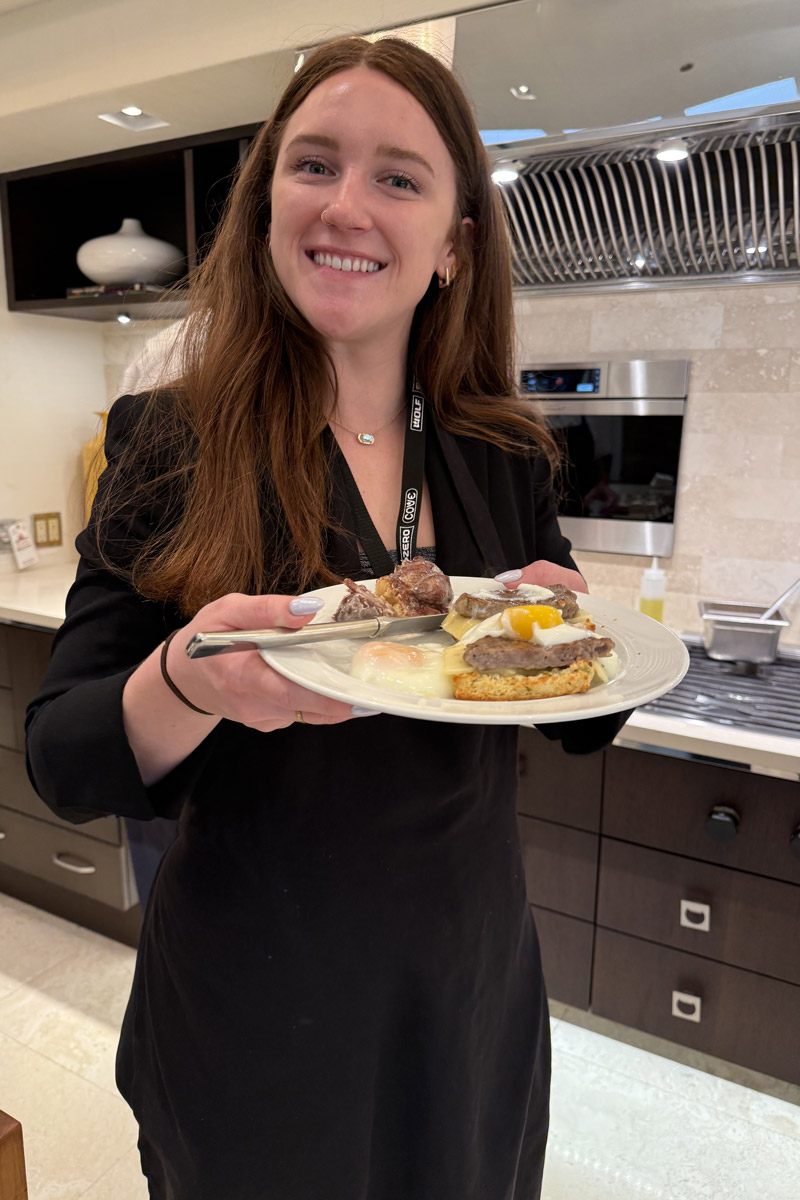
Lauren with the finished product — eggs benedict made entirely on Wolf appliances.
The Ice Experiment Nobody Expected
One of the more unexpected moments of the trip centered on ice. Sub-Zero previewed an upcoming clear ice maker — a machine that removes sediment, impurities, and air from water before freezing, producing perfectly clear cubes. To demonstrate the difference, the team ran a simple side-by-side: regular ice versus clear ice, each with a pour of Coca-Cola.
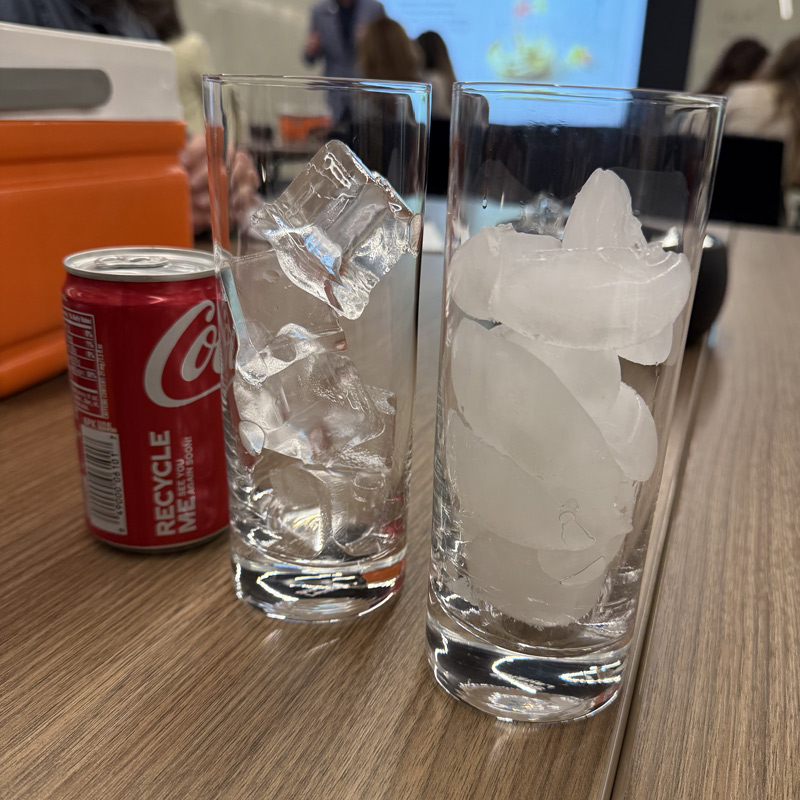
Regular ice (left) vs. clear ice (right). The difference in clarity is obvious — and so is the taste.
“The glass with clear ice didn’t fizz up when we poured,” Lauren noted. “And somehow the Coke tasted smoother. Still carbonated, but without that overpowering burn.”
It’s a small detail. But it’s the kind of detail that Sub-Zero builds entire product philosophies around.
A Company That Remembers Where It Started
Part of the campus visit included a history display tracing Sub-Zero’s origins. The team still keeps early-generation refrigerators on display — including a vintage round-top freezer from the 1950s and a polished stainless model from the brand’s early era. Both felt less like museum pieces and more like a deliberate reminder of what the company is building toward.
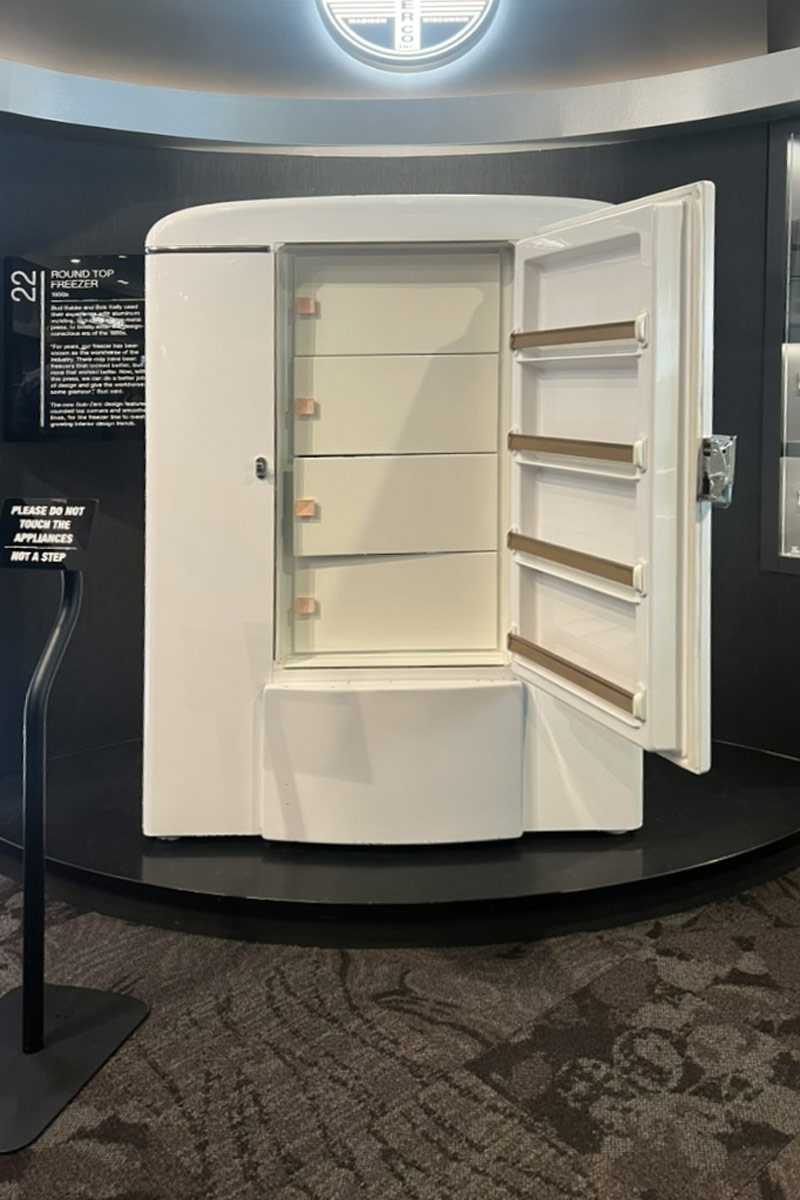
A Sub-Zero round-top freezer from the 1950s, still part of the campus history display — a nod to where it all started.

An early stainless Sub-Zero. The brand’s commitment to preservation extends to its own history.
Kelly noted that Sub-Zero still has the very earliest versions of their refrigerators on display — not as nostalgia, but as a grounding principle. “They never lose sight of what they do,” she said, “which is to enhance people’s experience with food.”
What Actually Gets Made Here
The factory tours were a reminder of why these appliances carry the price tags they do. Every unit passes through multiple quality checkpoints during assembly — and if something is flagged, it gets pulled from the line. It doesn’t get discounted and shipped. It doesn’t become a floor model. It gets evaluated and, if fixed, offered to employees at a reduced price rather than reaching the public.
“We’ve heard for years that Sub-Zero, Wolf, and Cove have the fewest service calls of any appliances,” Lauren said. “Walking the factory, I finally saw why.”
Kelly added another detail that stuck with her: the precision scanning equipment used during manufacturing can detect a deviation of 1/111th of an inch — roughly the equivalent of splitting a human hair into four equal parts. And the company’s automation hasn’t come at the cost of its workforce. Robots are used to support workers, not replace them.
Farm to Table. Literally.
The campus includes a working farm — The Barn — where vegetables are grown, harvested, and used directly by the on-site culinary team. What can’t be eaten fresh gets preserved: pickled, jarred, and labeled with the year. The campus also keeps beehives for fresh honey.
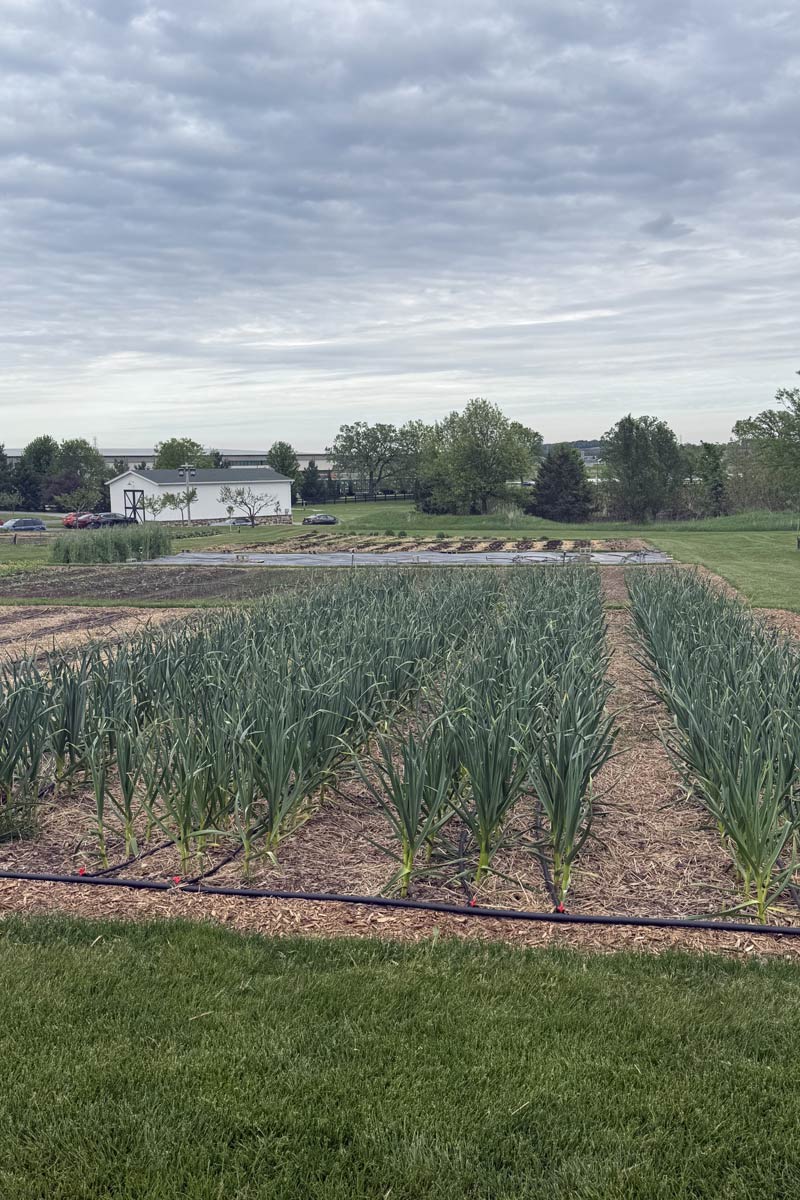
Rows of garlic growing in the campus garden. Produce grown here goes directly to the culinary team’s kitchen.

The Barn’s pantry counter: house-made preserves, pickled vegetables, and a raw honeycomb frame dripping fresh honey. All of it sourced from or made on the campus.

The Barn, a centerpiece of the Wolf | Sub-Zero | Cove campus, where culinary training and sourcing come together.
It’s a detail that seems almost too curated to be real — a refrigeration and cooking appliance company that grows its own food on-site to demonstrate what its products are actually for. But it works, because it’s genuine. The whole campus is organized around a single idea: that food matters, and the tools people use to store, cook, and care for it should be worthy of it.
What It Means for Our Clients
There’s a gap between reading a spec sheet and being able to genuinely advise someone on a $15,000 appliance purchase. After a few days in Madison, Kelly, Samantha, and Lauren came back with something better than product knowledge. They came back with conviction.
“I genuinely understand why Sub-Zero, Wolf, and Cove are considered such an essential part of luxury home remodeling,” Samantha said. “The trip gave me stronger product knowledge, but also more confidence and excitement when discussing them with clients.”
That’s what this kind of training is actually for. And that’s ultimately what you’re getting when you work with a Drury Design team that invests in it.
Interested in talking through appliances for your kitchen project? Give us a call or stop by our showroom!