

Alicia Saso Talks Design: Bold Kitchens, Natural Stone and More
With nearly 20 years at Drury Design, senior designer Alicia Saso, CKBD, knows how to turn a project’s challenges into opportunities — even when they involve pipes that can’t move or a refrigerator that needs more room. In our latest conversation, she shares how she reads a home for clues, helps clients sort through ideas and makes room for personal touches, including a kitchen with plenty of black, gold and sparkle.
Q: What do you tend to notice about a home during your first visit that the homeowners may have stopped noticing?
A: The first thing I notice is their style. What colors do they use? What type of furniture do they have? Are there decorative accents and family pictures on the walls? Some people are very minimal, and some like to have things around them. Even if they’re ready for a different look, their home gives me insight into how they’ve made it a space for themselves and their family.
The second thing is how they live in it. Life can get so busy that you’re just going through the motions — walking in, putting down your purse and keys, taking off your shoes. You don’t necessarily step back and look at how the space is being used or underused.
Are the kids’ backpacks piled on the floor because there isn’t an organized mudroom? Is there proper lighting? Are the staircase handrails outdated? Would crown molding help finish a room? Are there things I can design to address these life rhythms? I’m looking at functional things and aesthetic things. There’s so much a home can tell you.
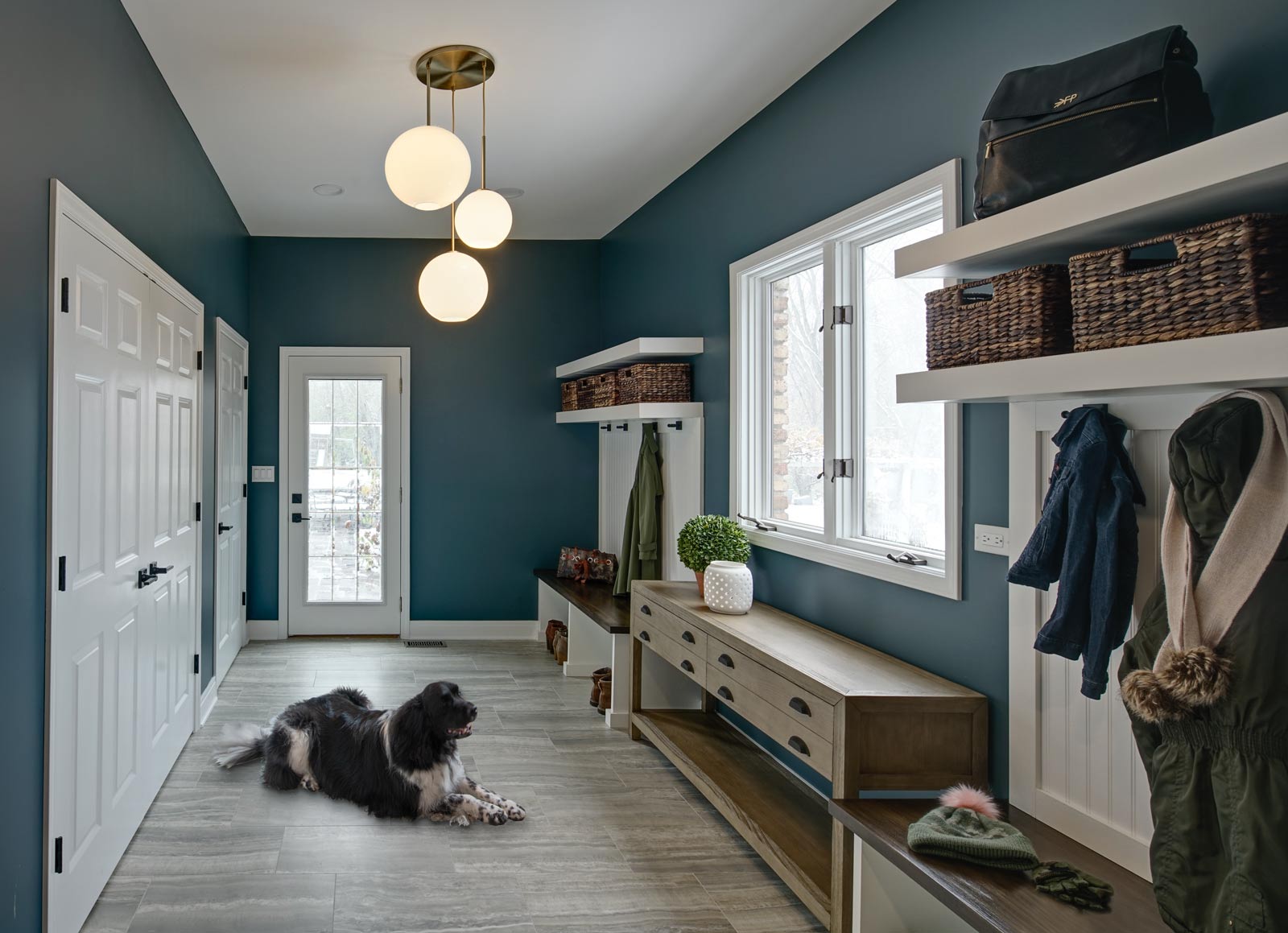
Alicia designed mudroom storage solutions for everyone in this family, including Sugar Bear.
Q: What questions help you understand how a client actually lives in a space?
A: Our questionnaire is really valuable because a simple question can lead to a much bigger conversation.
You might ask someone how many sets of dishes they have, and they say, “One,” and you move on. Someone else might say, “I have my everyday dishes, a china set and another set for parties. Here’s where I keep them, but I’d really like them all in the kitchen.”
Different questions bring out different things for different clients. I want to know what they love about their space and what drives them crazy. What works well? What could be better? Then we can improve it and still have it reflect them.
Q: When a client brings you several ideas that don’t seem to fit together, how do you help them find a direction?
A: There’s so much inspiration around us. You might see something in a restaurant, in someone’s house, on Instagram or in a magazine. A client might bring me pictures that represent several different styles, but most of the time there’s an underlying theme. My job is to uncover it.
Maybe every picture has light, natural-colored floors. Or several involve a certain theme. The client might not have noticed that connection, but I can see that it’s something they’re drawn to. We talk through the pictures and what they like about them. With all the inspiration available, it’s easy to get pulled in different directions. Finding those common elements helps us figure out where to go.
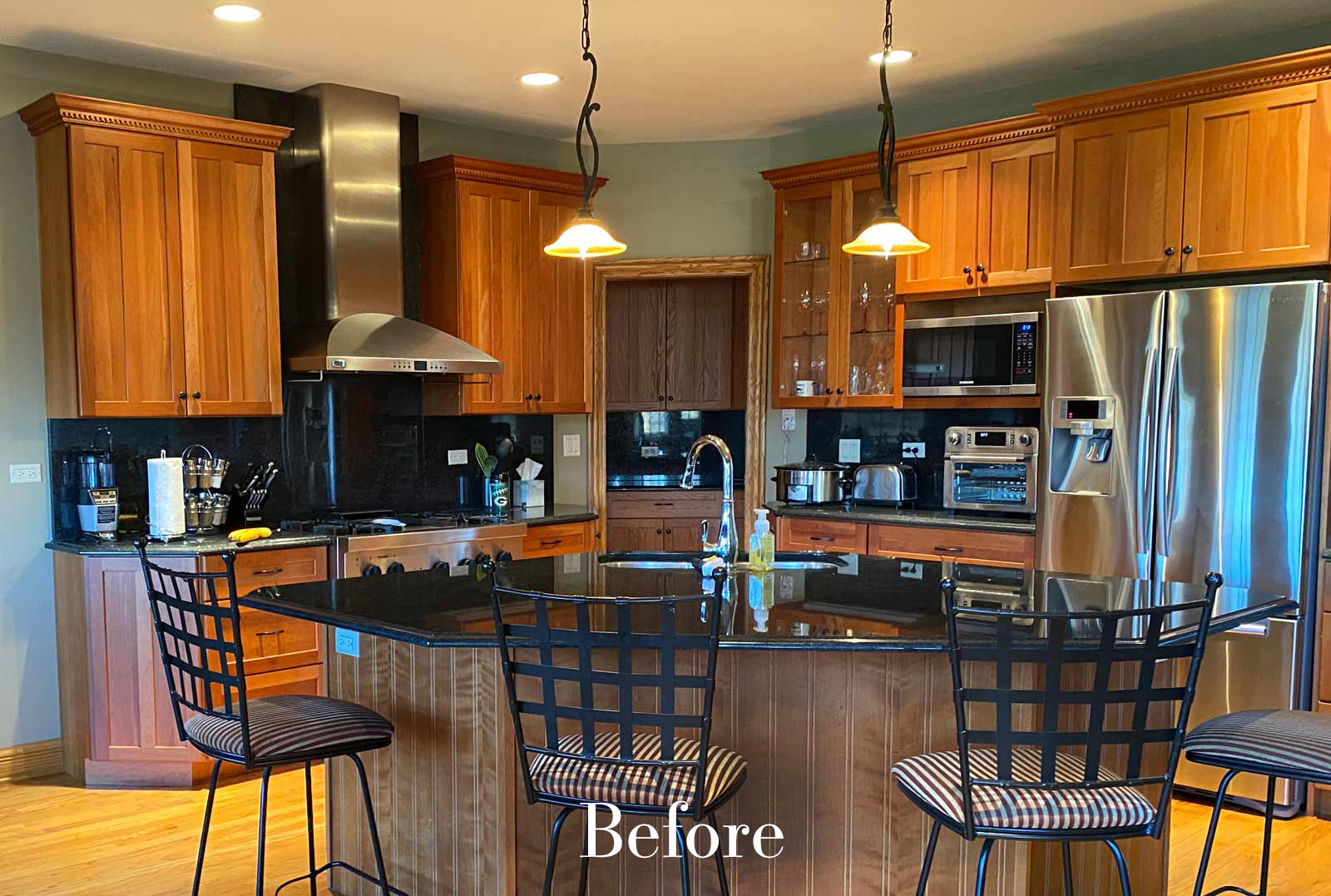
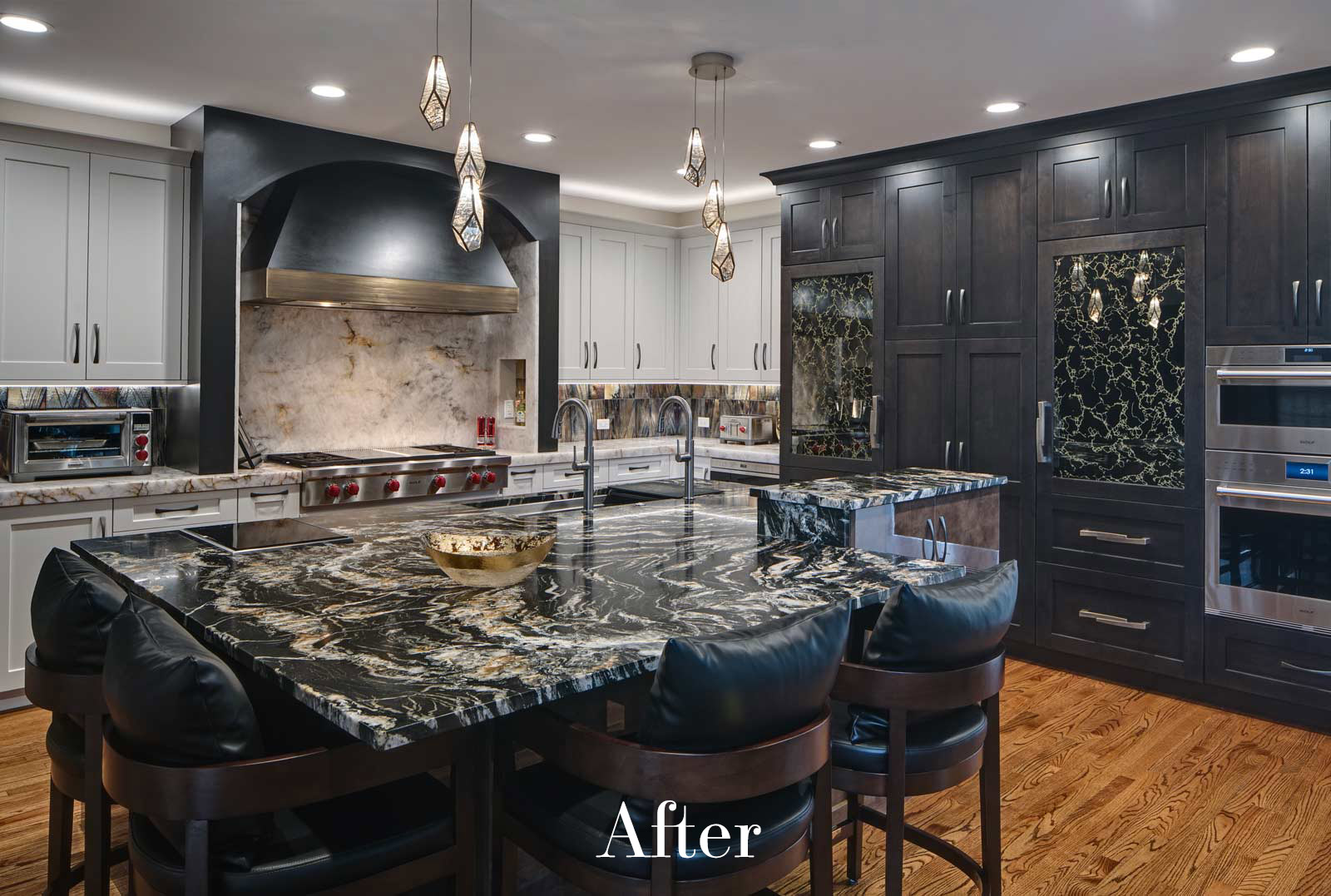
Alicia helped this client give her kitchen a new look and improve how it works for her family today.
Q: Tell us about a collaboration with a client that shaped the finished space.
A: I have a longtime client whose kitchen is such a reflection of her personality. She doesn’t like bland. She doesn’t like neutral. She wants that wow and that pop.
There’s black, gold, sparkle and glass tile. There’s a lot of movement in the countertops, antique mirrors on the refrigerator panels, iridescent glass tile in the bar area and a big metal hood. There’s a lot happening, but it’s so her.
It was a big collaboration because she had a very distinctive sense of style and was willing to go outside the box. My job was to help guide those choices. She took risks, and they really paid off in that space.
Q: Has anything changed about your approach to design over the years?
A: I encourage clients to be more expressive and incorporate more color. The safe option can be to go very neutral and monochromatic. I love that look, too, but there are so many colors and materials we can work with.
Design is personal. Someone might have traveled to Europe, found a piece they loved and wanted to bring it into their home. Another person might look at the finished room and wonder why it’s there, but they don’t know the story behind it or what it means to the homeowner.
I’m more interested in helping people take those risks now. And some things aren’t permanent. Paint, a furniture piece or an accent can change. It’s okay to be expressive in your own home.
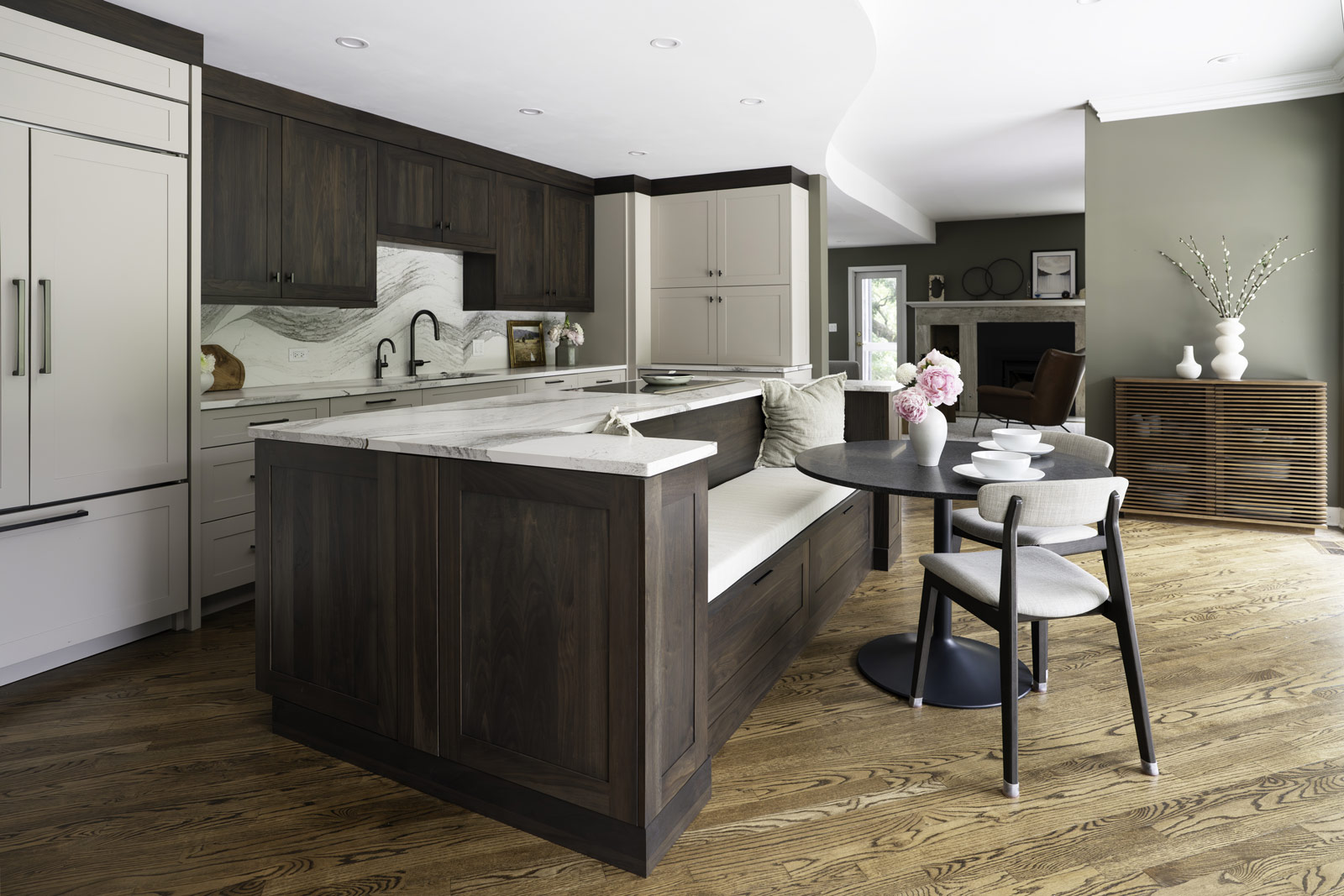
This kitchen remodel by Alicia helped children get more involved in family cooking.
Q: Describe a constraint that led you to a better idea.
A: We come across constraints all the time. They might be structural, related to the budget or connected to something the client wants. They challenge us to think differently, and new ideas can come out of that.
Years ago, I worked on a kitchen where the clients loved the layout, but the refrigerator they ultimately selected needed more space for the doors to open. We didn’t want to change the whole plan. Instead, we were able to angle a wall leading into the pantry area.
That gave us the clearance we needed for the refrigerator and opened up the passage between the kitchen and the hall. I’m working on another project for those clients now, and they still talk about what a great idea that was.
More recently, I worked on a condo in Florida where pipes ran from the floor to the ceiling through the kitchen. We initially thought we might be able to move them, but we couldn’t. We incorporated them into a long island, enclosed them with drywall and wrapped the base of that enclosure in stone. It looks like an architectural element that belongs there. You wouldn’t know we were hiding pipes.
So, surprises can turn into something good. They don’t have to become an eyesore!
Q: What’s a design decision that can look small on paper but make a big difference once it’s installed?
A: Lighting. On a plan, you see the recessed lights, a decorative fixture here and another one there. It can seem like a routine part of the process.
But once it’s installed, with dimmers and the different types of lighting working together, it completely changes the feel of the room. You can change that feeling throughout the day. I always say that lighting is what really finishes a space. That’s true in a powder room, a family room, a kitchen or a basement. It has such an effect on the mood.
Is there a material or detail you’re especially drawn to lately?
Natural stone. Quartz has been so popular for the last ten years — it’s functional and low maintenance. But there’s so much beautiful natural stone out there, and there are so many places to use it beyond countertops.
Think about backsplashes, hoods, island leg details, fireplace surrounds or even stair risers. Then there are the different edges and details you can create with a piece of stone. I’m interested in exploring more of those possibilities. Where else can we use it? What can we do with it? It can add such a distinctive detail to a home.
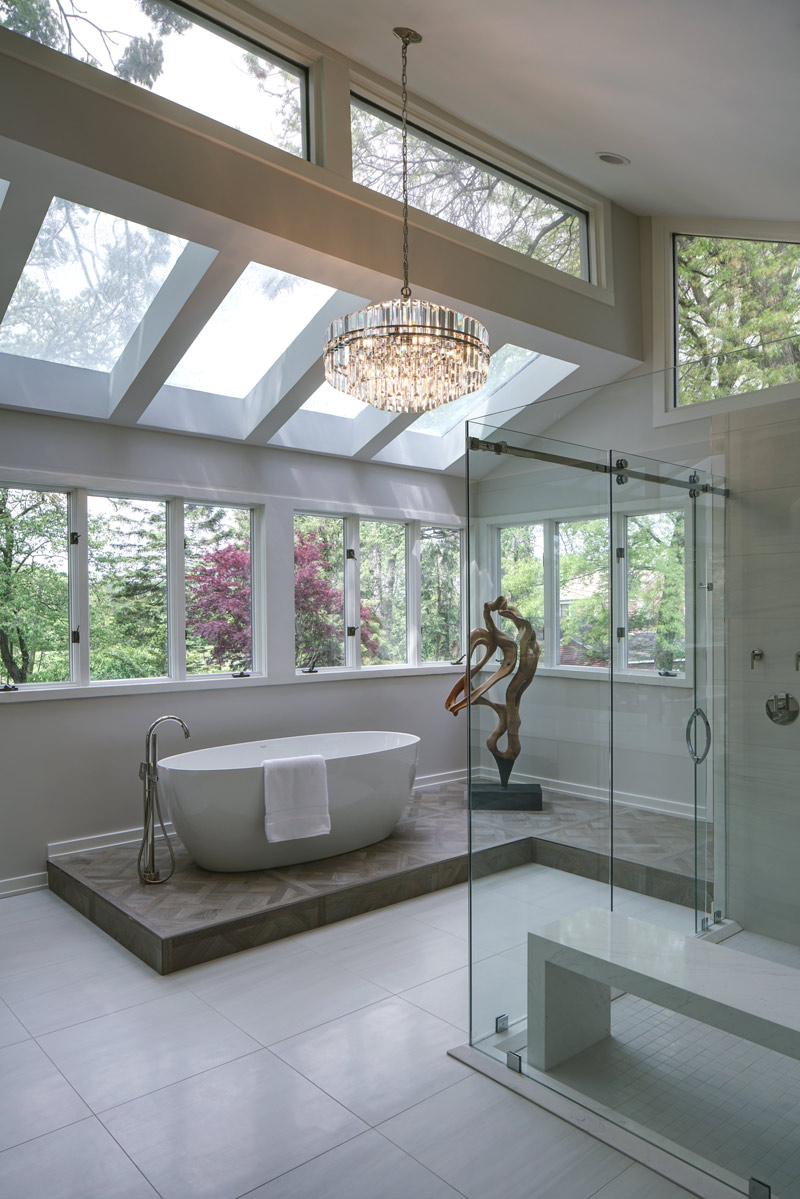
Windows and skylights bring natural light into this primary bath in Indiana, one of Alicia’s personal favorites.
Q: Which completed projects feel especially close to your own taste?
A: Two primary bathrooms in Indiana come to mind.
One is open, somewhat contemporary and neutral, with a mix of stone and porcelain. I love the windows and skylights, and the shower is very open. The whole space feels organic, light and soothing. Your eye moves through the room rather than jumping between a lot of competing focal points. It’s something I would design for myself.
The other is in St. John, and it’s close to ten years old now. It has floating cabinets, warm wood tones, beautiful decorative lighting and natural stone throughout the shower, countertops and floor. It’s a large bathroom with separate areas for each person.
I still love it. When I look at the pictures, it doesn’t feel like something we did that long ago. Both bathrooms were huge transformations, and they’re still two of my favorite spaces.
Q: What do clients tend to learn about their own tastes during the design process?
A: Sometimes they realize how much their taste has changed. They may have been thinking about a remodel for years and have pictures saved on Houzz or Pinterest. Then they look at one and say, “I saved this years ago. I don’t like it anymore.”
They’re also seeing new things throughout the process, which helps them figure out what they like now.
Something else that happens often is that we come full circle. At the first presentation, I’ll show materials and they’ll say, “I like this, but I want to see more.” It’s a big investment, so I understand wanting to explore the options. We might look at more tile, cabinet finishes, door styles and hardware, then come back to something they liked at the beginning. Maybe we tweak it a little, but looking at the alternatives can help them feel sure about that original choice.
Q: What first drew you to residential design, and what keeps you interested in it?
A: When I was in the interior design program at College of DuPage, I found an internship with a wonderful designer in Burr Ridge. She worked out of her home and had a full list of clients, mostly through word of mouth. This was more than twenty years ago, before people were using social media the way they do now to find a designer.
That was my first real work experience in the field, and it showed me how personal residential design is. You’re in someone’s home, helping create spaces they’re going to use and enjoy every day.
At Columbia College Chicago, our work focused on commercial design. I loved that, too — hotels, offices and stores are interesting on a completely different scale — but I missed the personal connection with the client.
That connection still keeps me interested. At the end of a project, seeing how happy someone is with their home is incredibly fulfilling. We’re making a change in someone’s everyday life and in how they enjoy time with their family and friends. That feels good.
Q: Outside of work, what finds its way into your design thinking?
A: My husband and I visit resorts each year, and there’s one particular resort brand whose design always impresses me. We visited a new location a few years ago, and I was taking pictures of everything: the materials in the room, the shower threshold, how they did the shower glass, the restaurants and the indoor and outdoor spaces.
I’m looking at how those details could work in our projects. Sometimes I’ll bring an idea to our operations manager and ask, “How can we engineer this? They did it — how can we do it?”
I take pictures wherever I see something interesting. It might not be for a particular client. Sometimes it’s just a way of looking at something we do every day in a different light.
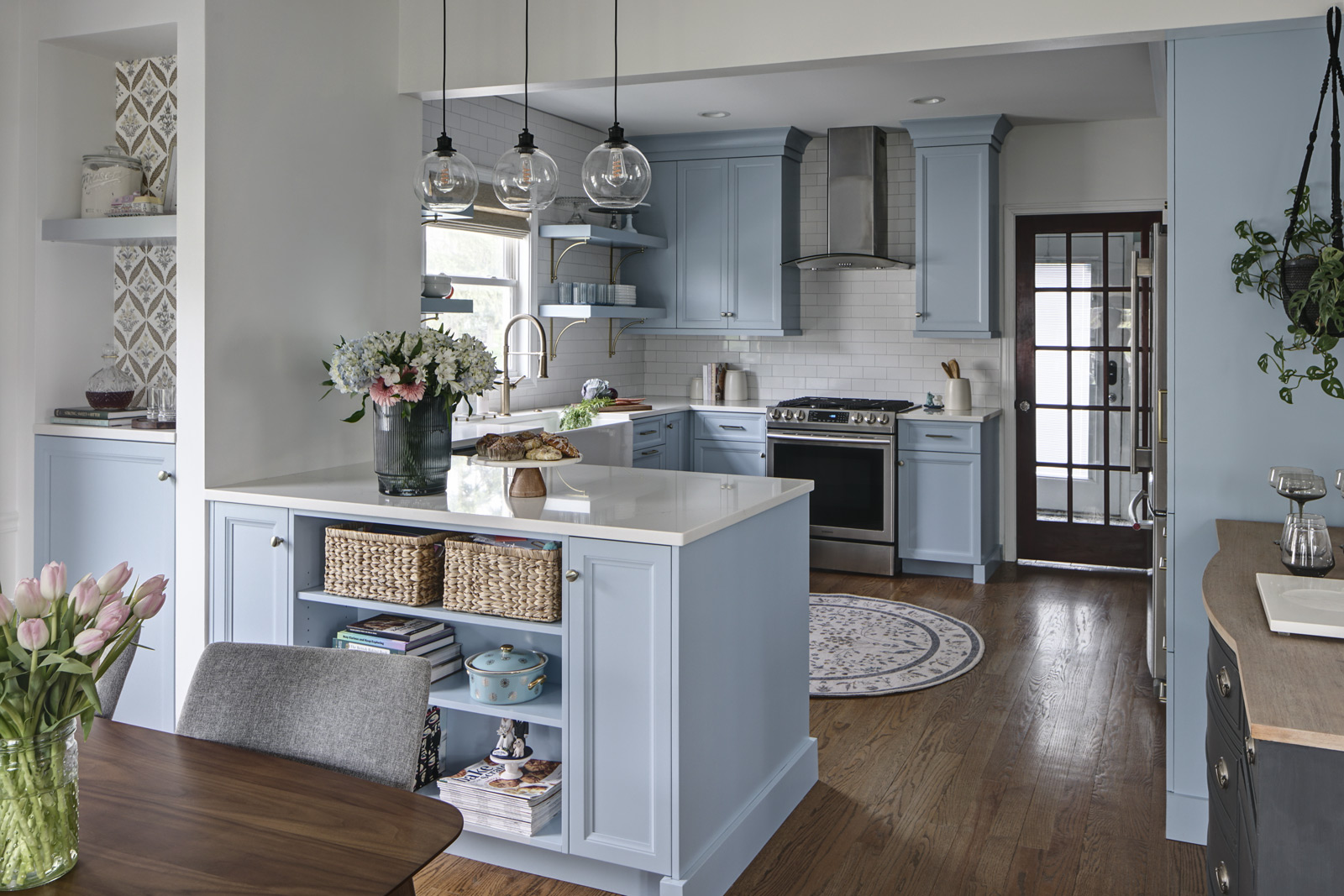
One of Alicia’s long-time clients is a fellow Disney fan. They had fun collaborating on this princess-inspired kitchen remodel.
Q: What’s something people might not know about you?
A: I absolutely love Disney World. We’re a Disney family, and we go every year — whether my husband likes it or not!
It’s special to be there with your children, even as they’re growing up. My girls are now a tween and a teen, and we still love doing themed outfits each day with matching ears at the parks. You can be a kid, go on the rides and enjoy the food. It’s just fun.
A friend’s daughter, who’s a senior in high school, said, “It’s a lifestyle.” And I thought, “You’re right!” If you know, you know.
There are plenty of other beautiful places in the world, and I love visiting those, too. But Disney is a big thing for our family.
Q: Anything else you’d want someone considering a project to know?
A: We love working in different styles. Sometimes someone calls and says, “My home is really modern,” or, “My home is really traditional, but I don’t see something like it on your website.”
The projects you see reflect the opportunities we’ve had and what those clients wanted. As designers, we don’t always get the opportunity to work in every style we enjoy.
I wouldn’t want someone to hesitate to reach out because they don’t see their exact inspiration in our portfolio. Let’s talk about what you have in mind.
Considering a remodel? Explore Alicia’s work and get in touch.
Reach her at alicia@drurydesigns.com or 630-446-7640 to discuss your project!